The Real Reason No Two Sites Agree on Hilltop's Home Prices
August 20, 2026
August 20, 2026
Ask three different sites what a home in Hilltop costs right now and you will get three answers that disagree by hundreds of thousands of dollars, all describing the same nine-block neighborhood in the same year.
Redfin puts the median sale price at $1.9 million for the three months ending in May 2026, up 16 percent from a year earlier. Zillow's home value estimate, pulled in August 2026, sits at $1.54 million, up half a percent over the past year. Movoto had Hilltop's median list price at $2.3 million in May 2026. Orchard, working from just five closed sales in a 30-day window that closed in early April 2026, reported a median of $1.67 million, down 24 percent year over year. 5280 Magazine's 2026 neighborhood ranking put the average sale price at just over $2 million for the first time, roughly $129,000 above Washington Park, the next most expensive Denver neighborhood on their list.
None of these numbers are wrong. They are measuring different things in different windows, which explains some of the spread. But that alone does not explain why a 30-day window in early spring can show a 24 percent year-over-year drop while a three-month window closing just a few weeks later shows a 16 percent gain, in the same neighborhood. That kind of whiplash is not a data problem. It is what happens when a headline median tries to describe two structurally different housing products as if they were one.
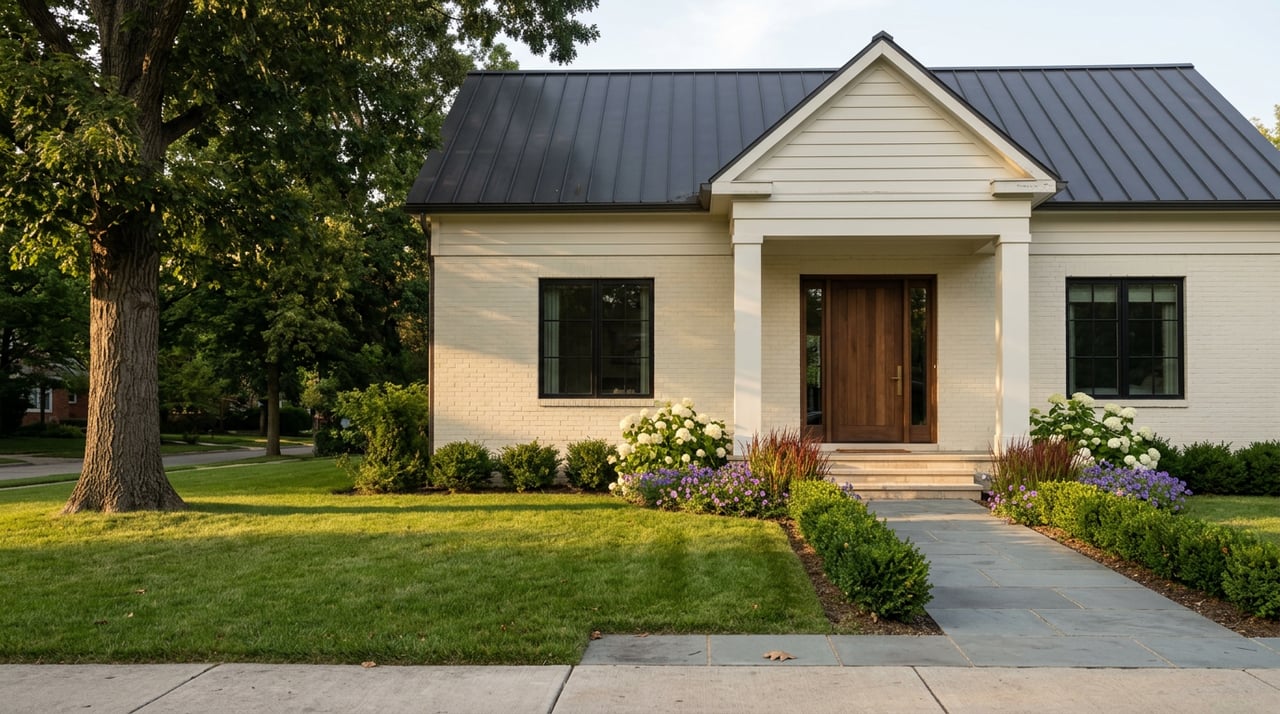
Walk a block in Hilltop and you will see it plainly: a 1950s brick ranch or English Tudor sitting next to a modern custom build that fills nearly the entire lot. This is not incidental variety. It is the direct result of a zoning decision made a generation ago that solved one problem and left another wide open.
Hilltop sits inside the Hilltop Heritage Conservation Overlay District, known in Denver's zoning code as CO-1. The overlay exists to stop lot-splitting. The Denver zoning code text spells out the rule:
Any zone lots in this overlay Zone District that existed on July 21, 2000, may be amended or subdivided only if each of the zone lots that are created or result therefrom is not less than 75 feet wide at any street setback line for structures.
There is a narrow carve-out for lots that already exceeded 27,900 square feet as of March 7, 2000, but the operating rule for everyone else is simple: you cannot cut a Hilltop lot into two smaller ones. What the overlay never touched is what a buyer can do with the house sitting on that lot. Tearing down a 2,200-square-foot ranch and building a 5,000-square-foot home on the same generous parcel is fully allowed. The overlay protected the size of the land. It said nothing about the size of the structure on it.
The result is a neighborhood where lot dimensions stayed frozen while the buildings on them split into two distinct categories: preserved original stock from the postwar building boom, and ground-up new construction that maximizes what the lot allows. Same street, same zoning, two different products with two different price behaviors.
That split is not an abstraction. In June 2026, a historic Hilltop home became the center of a public demolition dispute after a modern infill project was proposed for the site, a story reported by The Cherry Creek News. The property falls within the CO-1 overlay, and city planning officials confirmed that any demolition request involving a landmarked property or a home inside a designated historic district requires a pre-application review through Denver's Landmark Preservation program before a permit moves forward. Preservation advocates, including Historic Denver, recommend that anyone eyeing a scrape confirm whether a Certificate of Demolition Eligibility has already been filed on the property, rather than assuming the lot is a clean slate.
That single case shows exactly why a buyer cannot treat every Hilltop listing the same way. One home on generous acreage might be an easy scrape. The one two doors down might carry landmark review that adds months to any rebuild timeline. Nothing on a listing sheet tells you which is which. You have to ask.
Hilltop does not sell in high numbers. Redfin counted 40 closings in May 2026, up from 29 the year before. Orchard's 30-day window ending in early April 2026 caught only five. When a market this thin has two structurally different products trading in it, whichever type happens to close in a given month decides the headline number. A month where three of five closings are original-condition ranches will read as a soft market. A month where new-construction scrapes dominate the closings will read as a spike. Both readings can be technically accurate and both can be misleading about where the market actually sits, because neither is describing the whole picture.
This is also why price-per-square-foot figures cluster closer together than the raw medians. Redfin reported $544 per square foot, up 8.3 percent year over year. Movoto reported $541. Orchard reported $551.41. Those numbers agree far more than the medians do, because price per square foot partially corrects for the size mismatch between a 2,200-square-foot original ranch and a 5,000-square-foot new build. The raw median does not correct for anything. It just reports whatever happened to sell.
Layer one more factor onto this. Homes inside the Steck Elementary attendance boundary have shown a notably higher rate of resale into scrape projects than the neighborhood overall, based on one closed-comparable dataset tracked through 2025 that put the figure between 60 and 70 percent of original-condition mid-century sales in that boundary. Bromwell Elementary serves another portion of the neighborhood. A buyer evaluating two listings a few blocks apart, one inside the Steck boundary and one outside it, may be looking at different odds that the home next door gets rebuilt within a few years, which affects both resale comps and the immediate experience of living next to active construction.
None of this means Hilltop pricing is unknowable. It means the headline median on any single site is the wrong tool for evaluating a specific address. Before comparing a listing's price to a portal's reported median, it is worth confirming a few things directly:
A listing priced at $1.7 million and one priced at $2.3 million a few streets apart may both be fairly priced. They are just answering different questions, one about a home you can move into, one about a lot you can build on.
If you are trying to figure out which Hilltop market a specific address actually belongs to, and what that means for your offer or your resale plan, Christine Nicholson has spent decades reading Denver's close-in neighborhoods block by block. Let's Connect and look at the comps that actually apply to the home you're considering, not the median that doesn't.
Stay up to date on the latest real estate trends.

Get assistance in determining current property value, crafting a competitive offer, writing and negotiating a contract, and much more. Contact Christine today.