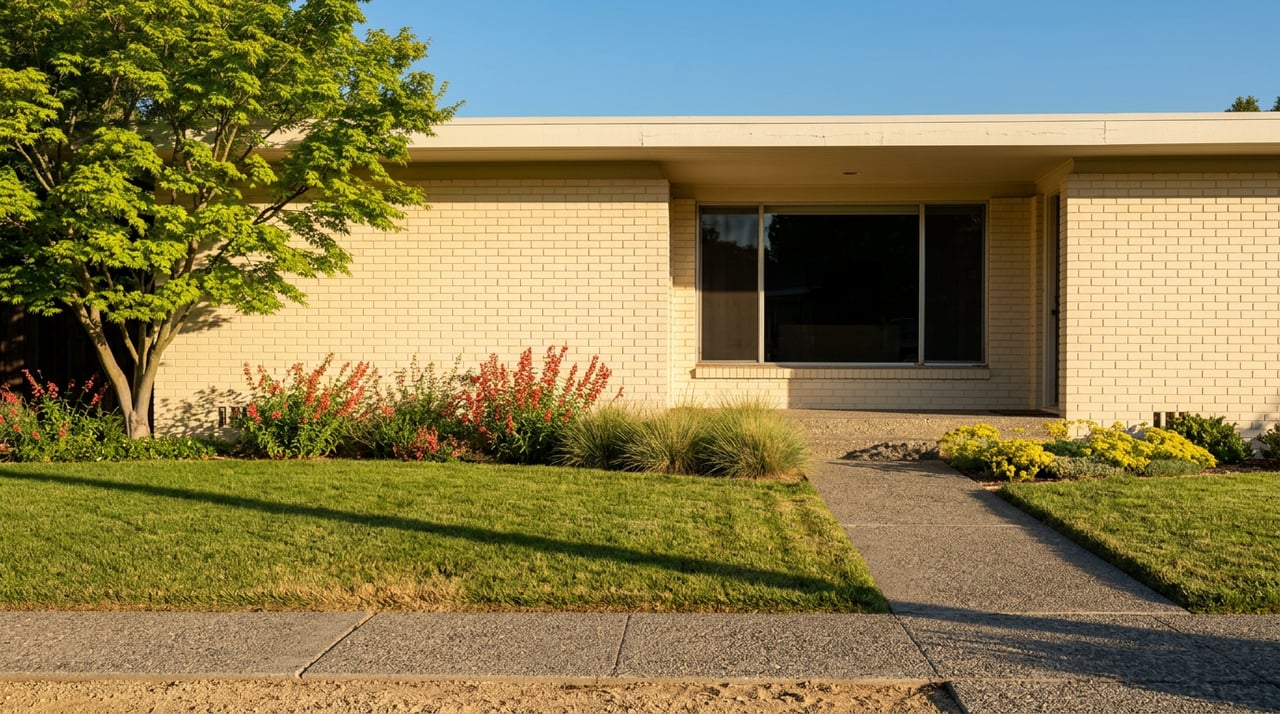
Every Stop on Hilltop's Saturday Morning Was Placed There on Purpose
May 28, 2026
May 28, 2026
The loop takes about two hours if you linger. It starts on South Holly Street at a bagel counter that opens at 6:30, moves through four decades of local grocery history, and ends at a park where a six-foot sundial was calibrated to the exact latitude and longitude of Denver. Somewhere along the way, thirty-two steel arches catch the morning light around you without announcing what they are. Hilltop residents have been running some version of this route for a long time. The part most of them don't know is that the whole thing was constructed by other people, on purpose, over the course of a century.
The Holly Street micro-cluster and Cranmer Park were both shaped by deliberate choices: a leasing director who noticed a breakfast-sized gap in a commercial block, a parks manager who bought a house next to a park he wanted to redesign, an artist who built a sundial accurate enough to cast a meaningful shadow. The Saturday morning that feels so naturally Hilltop is, in fact, a designed experience. It has just had enough time to feel inevitable.
Call Your Mother Deli opened at 217 S. Holly St. after the building's leasing team observed that the cluster already had ice cream and dinner but nothing for breakfast. The DC-founded deli, which opened its first Denver location in Berkeley before expanding to Hilltop, operates on honey-baked bagels and sandwich combinations that lean deliberately playful. The Thunderbird, which layers maple chicken sausage with spicy honey, is the order that regulars defend most consistently. The shop opens at 6:30 seven days a week, which means it starts serving before most of the neighborhood is moving.
High Point Creamery sits immediately next door. The leasing director's description of the block at the time of Call Your Mother's opening was precise: breakfast, ice cream, and dinner, each occupying its own hour without competing for the same one. Pete's Fruits and Vegetables, which 5280 Magazine's 2026 neighborhood coverage identifies as a fixture for more than forty years, anchors the produce end of the corridor with Colorado-sourced fruits and vegetables, prepared foods, and a selection of Greek specialties that Pete Moutzouris has been stocking since the 1980s. Park Burger fills out the block for when the morning runs long and becomes lunch.
Four distinct stops within a single walkable stretch: a bagel counter, a produce shop with four decades of institutional memory, an ice cream parlor, and a burger spot. The hours are staggered. The offerings don't overlap. That is not a coincidence of the commercial real estate market. It is what happens when a block builds around gaps rather than duplicating what already exists.
On a Saturday in late May, with the morning still cool enough that the coffee earns its keep, the line at Call Your Mother tends to clear faster than it looks. The walk north from there is unhurried. The block doesn't feel like a destination so much as a sequence — one stop pointing to the next without any of them requiring a decision.
Cranmer Park sits off Colorado Boulevard between East 1st and East 3rd Avenue, roughly three blocks from the Holly Street cluster. The park carries the name of George Cranmer, Denver's Parks Manager, who in 1926 bought a house on the edge of what was then called Clayton Park and began remaking it according to his own vision of what a neighborhood park could be. He hired landscape architect Saco Rienk DeBoer to design formal terraces. He commissioned artist Arnold Ronnebeck to build a sundial calibrated to Denver's exact latitude and longitude. The sundial was set on a circular flagstone platform quarried from Colorado, surrounded by a low wall with the names and elevations of Front Range peaks cut into the stone. Cranmer donated his house and the redesigned park to the city in 1937. The park was renamed in his honor.
In 1965, vandals destroyed the sundial with dynamite. The city replaced it with a replica the following year, incorporating fragments of the original. That replica has been sitting in the same spot ever since, oriented toward the same peaks its predecessor was built to track.
The detail about the dynamite tends to change the way people look at the sundial. What appears to be a simple park fixture in a quiet residential neighborhood is actually the second version of a purpose-built astronomical instrument, reconstructed from its own ruins. The mountain peak names inscribed on the surrounding wall include elevations accurate enough that the wall functions as a low-grade geological record of the Front Range. Most residents walk past it weekly without knowing any of this.
BOWS, a permanent public art installation by Denver-based artist Patrick Marold, extends that same logic across the park's lawn. The piece consists of thirty-two steel arches arranged in a radial pattern that aligns with the sundial's cardinal directions at the center of the park. The arches shift in appearance depending on the viewer's position, the time of day, and the season. Most people walking through BOWS on a Saturday morning are there for the mountain view. Both experiences are available simultaneously, and one does not require knowing the other exists.
The panoramic view from the sundial terrace runs from Longs Peak in the north to Pikes Peak in the south. George Cranmer positioned it that way. The view was not discovered. It was designed, installed, and then rebuilt after someone tried to destroy it.
The Hilltop Neighborhood Association published its 2026 farmers market guide in May, noting that season was opening for Denver's premier markets. The Cherry Creek Fresh Market, which Visit Denver identifies as the city's largest and which runs Thursdays from May 26 through September 17, 2026, is minutes from the Holly Street cluster. The HNA's guide describes nearby markets drawing more than 100 vendors alongside weekend morning programming, including run clubs and live music, that layers a social dimension onto what is otherwise a produce run.
Farmers market season doesn't reinvent the loop. It adds a layer. The sequence on a late May Saturday looks like this:
That sequence fits inside six walkable blocks. It requires no planning beyond the first step. In May and June, with the mornings still cool and the market vendors setting up around the corner, it is at its best.
The best neighborhood mornings don't announce themselves. They become the thing you do each week without deciding to, until one day you realize you have been doing it for years. Hilltop's version happens to include a Ronnebeck sundial that was blown up and rebuilt, a DC bagel institution that arrived because a block needed breakfast, forty years of Pete's, and thirty-two steel arches that follow the sun.
Christine Nicholson has spent more than three decades living inside Denver neighborhoods like this one. If Hilltop is on your mind for reasons beyond a Saturday morning, she's glad to talk through what that looks like.
Stay up to date on the latest real estate trends.

Get assistance in determining current property value, crafting a competitive offer, writing and negotiating a contract, and much more. Contact Christine today.